Cycles, Karma, and the Webs We Weave

I shared the following Loveletter to subscribers today, and felt to also share it here. If you are not subscribed and would like to receive my musings and contemplations with every new and full moon, scroll to the bottom of this page and enter your email. Enjoy!


What are you Choosing to Weave?


Just in the past few days here in the Deep South, there’s been a noticeable shift. The air is a little cooler, the day a little shorter, the singing cicadas have made way for the chirping crickets.


Autumn has arrived.


Regardless of your location on this beautiful blue planet, we all experienced an equinox this week—a day of balance, harmony between Light and dark, day and night, a reminder of the natural shift in cycles.


For many of us, this summer was heated, in so many ways.


For me, it was intense and profoundly clarifying.


Now comes a new season. For those of you in the Northern Hemisphere, we greet Autumn; if you’re “down under,” you’re welcoming Spring.


The shift in seasons reminds us that our life is lived in cycles—birth, life, death, rebirth. We cycle again and again. There’s a natural ebb and flow to the rhythm of our life.

For some, a career will last an entire lifetime; for others, they will cycle through many careers. Some relationships will carry us through many seasons. Others are meant to show us something of value in a short and potent season before reaching their natural end.

I’ve been observing spiders a lot recently.

Small and large, they weave beautiful tapestries, jewels of light shimmering at each intersection. Sometimes these majestic webs last many days, some only for one night before a bird, bat or heavy rain tears through them.

Sometimes, the spider simply rebuilds in the same spot.

Other times, they move locations.


I'm reminded of an ancient Buddhist teaching called Indra’s Web, or Indra’s Net, that imagines an infinite web with a jewel at every intersection. Each jewel reflects every other jewel in the web, and within each reflection are all the others, again and again.

Nothing existing entirely on its own.

Each thread connected. Each jewel reflecting the whole.


Watching the spiders weave and reweave their worlds, I’ve been contemplating the webs we create in our own lives—the relationships, identities, dreams, responsibilities, patterns and stories that connect us to one another.

And I’ve received these contemplations:

  • What webs have you woven that are being dissolved now?

  • Are you clinging to a dissolving web, frantically trying to salvage what remains?

  • Can you honor what that web provided and let it go?

  • Will you rebuild in the same location, or shift to receive a new perspective?

  • What else in the web shifts when you choose to weave differently?


Nature has many teachings to share for those who create space to observe.

What wisdom is this shift of seasons offering you?


This month’s Full Moon occurs in the constellation of Pisces, in the nakshatra of Uttara Bhadrapada.

Take a moment and think back to what was arising for you in March of 2025.


A year and a half ago, we experienced a New Moon Solar Eclipse in this same nakshatra. If you are one who journals, look back in your journal. See what was being illuminated then, what remained hidden, what karmic patterns you were weaving.


On March 29th, we had what we referred to as a “pile-up in Pisces,” or a “party in Pisces,” when five Grahas—Sun, Moon, Mercury, Venus and Rahu—came together in Pisces to offer the deepest of teachings. Just a few hours after the eclipse, Saturn, Lord of Karma, entered Pisces and joined them.

Shani remains in Pisces today, walking backward through his retrograde and toward the territory illuminated by this Full Moon.

Karma is action - neither bad nor good - our action can liberate or it can bind. The beauty is that we get to choose what actions we take! 


Saturn’s teachings center on our liberation from bondage, inviting us to take responsibility for what we are weaving, to establish sacred boundaries, and to honor our responsibilities.


Uttara Bhadrapada holds the medicine of depth.


The eclipse we experienced 18 months ago with the depth of the ocean invites us to dive deep and discover what remains within and beyond the field of our subconscious. It offered us an opportunity to release past karmas and move forward in liberation. Within its shadow, we may have received insight into what karmas were complete, what subconscious grooves were coming into the Light, the realization of what we had been weaving, and the invitation to weave something new.


The wisdom of Uttara Bhadrapada is one that can only be received by those willing to dive into the depths of their being, where all is calm and still.


If we remain on the surface, we may be blinded and confused by the choppy waters of impermanence and illusion.


To me, this Full Moon offers us a completion of what began 18 months ago with that potent pile-up in Pisces. Reflect and receive.


We are being invited to look again at the web.


Contemplate what you've witnessed within your own life over the last year and a half. What remains, what has dissolved? What have you rebuilt, and what are you still holding onto?


With greater awareness now, ask yourself - What am I choosing to weave now?


Devoted to Love,

Pennie 🌹


A Season of Harvest When Everything Is Seemingly Falling Apart

I just returned from a beautiful retreat in the Appalachian Mountains, and I am still reflecting on what brought us all together.

I am always in awe of what brings a group of seeming strangers into the same place, at the same time. People with different lives, different stories, and different paths somehow find themselves gathered together, sharing space and witnessing one another.

As if it were Divinely orchestrated—and you better believe it was—every person in attendance, including the family holding the retreat, finds themselves in a season of profound change. Each of us, in our own way, have recently experienced loss.

And it got me thinking: What is there to harvest when so much loss is experienced in the season of harvest?

You see, traditionally, summer is known as a season of harvest. It is a time of reaping the fruits of our labor, when what was planted and nurtured in previous seasons finally begins to manifest.

We tend to think of harvest as abundance. As receiving. As finally holding in our hands the things we have worked so hard to grow.

But what if harvest is not always about what we materially gain? What if sometimes the harvest is what becomes visible when something is taken away? The spiritual gains created when you face life head-on, full heartedly.

What if what is harvested is clarity. Discernment. The wisdom earned through grief. What if the harvest is the resilience gained in making the hard, necessary choice. The recognition of what we can no longer carry.

What does it mean when you arrive at the season of harvest only to find that so much of what you have worked to build—relationships, friendships, your spiritual beliefs and identity—is seemingly falling apart?

This is where I find myself.

This summer brought experiences that profoundly changed my perspective on my life, my relationships, my beliefs, and the path I have been walking.

Instead of experiencing a summer of extroversion—of sharing teachings and expanding my work—this season asked me to step back and turn within. It asked me to let go of what needed to die and required me to take a hard look at my values, my ethics, and my beliefs.

It asked me to consider whether the life I was building still aligned with what I knew to be true.

Maybe it’s less, “Why is everything falling apart when I have worked so hard to build it?” and more, “What is this season revealing about what I built, what I believed, and what I am now being called to carry forward?”

I am learning that we all see through the lens of what we are ready and willing to see. Sometimes, change arrives gradually. Other times, it asks us to reconsider the stories, identities, and attachments we have carried for years.

One of the hardest parts of this season, for me, has been realizing that people I deeply love may not arrive at the same understanding I have. There are beautiful beings whom I have known as dear soulmates—people with whom I have shared friendship, devotion, love, and meaningful seasons of life—who are moving through change in ways different from my own. Some may understand this season differently. Some may continue to hold beliefs that I can no longer hold. Some may remain connected to paths I have found I need to leave.

And that, too, is a loss.

But I am beginning to understand that loss and harvest are not opposites. Sometimes, they are happening at exactly the same time. Sometimes, the harvest is seeing with clear vision after the illusion dissolves. Sometimes, the harvest is watching all that is no longer worthy of our energy or aligned with our values dissolve. Sometimes, the harvest is seeing what needs to be shed and releasing it without hesitation.

For me, the harvest of this season is acknowledging how much I have grown and how honestly I am meeting this moment. It is detaching from what no longer serves me while remaining willing to honor what once did.

It is learning to lead with an open heart and a discerning mind. It is trusting that discernment does not require bitterness, that letting go does not require rejection, and that choosing a different path does not diminish the love I once held for the one I was walking.

There is grief in all of this.

There is grief in realizing that someone you once regarded as wise and worthy of your trust can no longer hold the same place in your life. There is grief in loving people who choose a different path. There is grief in questioning beliefs that once shaped your understanding of yourself and the world.

There is grief in discovering that growth does not always feel like expansion.

Sometimes growth looks like contraction. Sometimes it looks like silence. Sometimes it looks like stepping away. Sometimes it looks like saying, “I can no longer participate in this.” And sometimes growth looks like staying deeply connected to your own heart while finding the courage to change your mind.

Maybe this is what I was being shown in the mountains: a group of seeming strangers, each arriving with their own experience of loss, gathered together at the very time of year we associate with abundance. None of us had arrived empty-handed after all.

Loss brought us to the circle, but our willingness to grieve—to feel, to surrender, to listen, and to be witnessed— yielded a harvest of its own: wisdom, tenderness, humility, clarity, a deeper appreciation for what remains, a greater reverence for what has been lost, and the courage to make room for what wants to come next.

And there, in the circle, we were reminded that even in our deepest seasons of loss, we are never alone.

Maybe the harvest was never only the fruit. Maybe it was also the clearing of the field, the gathering of what has ripened, the recognition of what has not, the honoring of what has died, and the wisdom of discernment.

I don't know exactly what the next season will bring, but I know I am not the same person who entered this summer.

And perhaps that is the harvest.

Not that everything I planted survived. Not that everything I believed remained intact. Not that everything I loved was meant to come with me.

But that I am standing here with clearer vision, deeper discernment, and a greater willingness to meet what is true for me—even when doing so asks me to release what I once believed would last forever.

Sometimes, the harvest is grief transformed into wisdom. And sometimes, the greatest thing we reap is the freedom to choose what we will carry into the next season.

Author’s Note:

In light of recent allegations concerning Anand Mehrotra, as well as reports of previous allegations spanning many years, I am no longer a student of Anand Mehrotra and have ended my public affiliation with him and Sattva Yoga Academy.

I do not condone the conduct described in these allegations. I believe the concerns and experiences that have been brought forward warrant serious attention, accountability, and meaningful response. I call on Anand and Sattva Yoga Academy to address these concerns transparently and to take responsibility for any harm that has occurred.

Given what has come to light, I cannot recommend Anand Mehrotra or Sattva Yoga Academy to students, clients, or members of my community.

Healing the Mother Line, conclusion

Part 2 of 2

Missed part 1? You can read it here.

As I shared in Part 1, I knew the Mother as a child. I knew Her through the Earth, through the changing seasons, through the garden, the trees, the water, and the rhythms of the natural world. But alongside that knowing, I was being conditioned into a religious worldview in which God the Father was supreme. The feminine form of the Divine was absent.

The Divine, as I was taught to understand Him, was male. The prophets who spoke for Him were male. The religious authority surrounding me was predominantly male. The feminine was not presented as an equally sacred expression of the Divine.

So perhaps I didn’t forget the Mother. I learned not to give Her the same authority.

It’s ironic to me that it was in India that I began to actively explore different emanations of the Divine Feminine principle. Ironic because India, as a society, is deeply patriarchal, even though religiously, many forms of the Divine Mother are worshipped and placed above many male deities.

This contradiction fascinated me. How could a culture so deeply shaped by patriarchy also hold such a rich understanding of the Divine Feminine? How much of what I was seeing had been shaped by colonization, and how much was something much older?

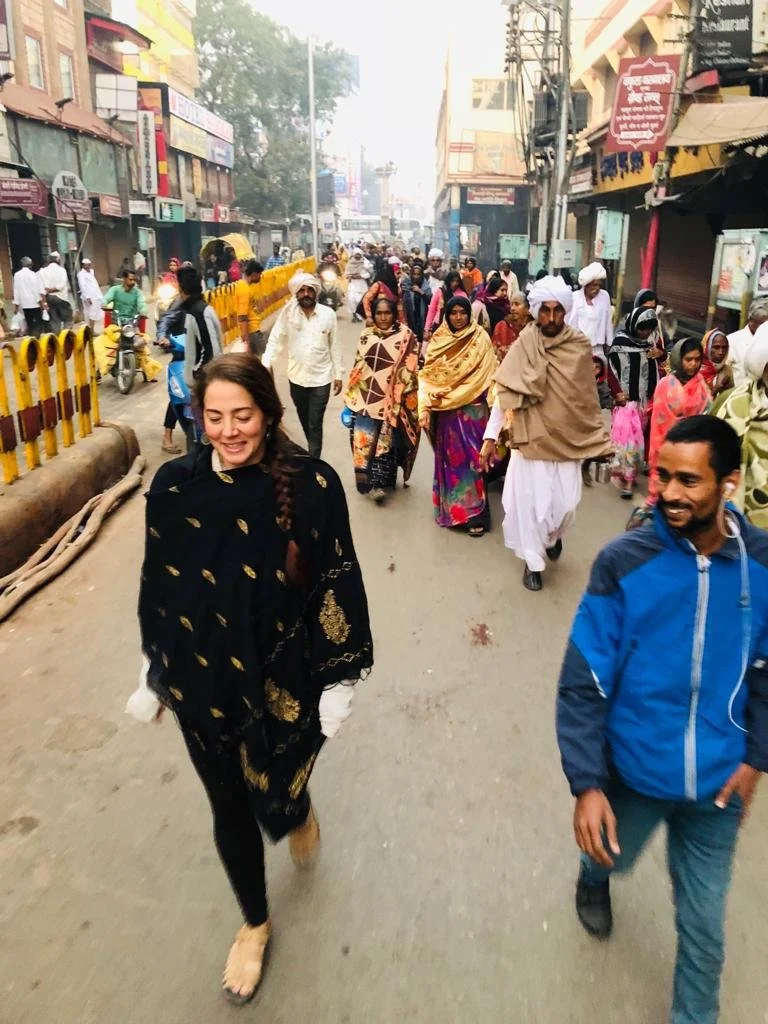
I first visited India in the fall of 2017. I was immediately overwhelmed by the colors, textures, smells, sounds, people and animals roaming the streets, cars, bikes and buses all going every direction all at once—so much life packed into such a small area. Everywhere I looked, there seemed to be contradiction. The sacred alongside the mundane. Piles of cow dung right outside the temple gates. An impoverished family living beneath a plastic tarp just outside my nice hotel complete with a soft bed and hot running water.

India didn’t fit neatly into the categories I was accustomed to. This is what I loved about it.

While I was there, I met an Indian teacher who challenged my viewpoint on the Divine—but more importantly, my relationship with the Divine. For all his shortcomings, he reminded me that having a direct relationship with the Divine was my inherent authority. I did not need someone else to mediate that relationship for me.

He also began introducing me to the many forms of the Divine Feminine revered in Vedic tradition—Durga, Kali, Lakshmi, Saraswati. For the first time, I was encountering a spiritual tradition in which the feminine face of the Divine wasn’t absent. She was everywhere.

Regardless of wealth or status, men and women visited temples daily. And temples were everywhere, from tiny altars on the side of the street to large marble structures.

But simply being surrounded by the Divine Mother didn’t mean I was ready to receive Her.

My conditioning came with me.

“Have no other gods before me” rang loudly in my head, alongside warnings against “worshiping false idols.” When I looked at the murtis, I thought, This must be exactly what they were talking about.

The first time I witnessed a puja—an early morning ritual honoring the Mother—it seemed performative to me. It felt culty. The women wore white and went through the motions as though they were on a stage. I didn’t feel the devotion. I didn’t witness a connection.

Yet, I remained curious.

Some part of me wanted to see beyond the conditioning of my childhood.

After twenty-eight days of Yoga Teacher Training, we were set to graduate on December 16th, my thirty-eighth birthday. I had avoided going to puja throughout the entire training, yet that morning, I felt called to go.

A different lead teacher was conducting puja that day. And this time, something was different.

As she moved through the ritual, I experienced her heart. I felt her deep love for the Mother. I understood that what I was witnessing was not simply a series of prescribed gestures. For her, this was an act of devotion.

Through this witnessing, something in me opened.

I began to understand that puja could be a performance—or it could be a sacred act of devotion. The ritual itself wasn’t what determined that. What mattered was the relationship beneath it: the relationship between the person performing the ritual and the Divine.

Perhaps what had changed that morning wasn’t the puja.

Perhaps it was my willingness to see Her.

So much internal—and external—metamorphosis followed that birthday. What had begun as curiosity became a deeper exploration of the Divine Feminine and, with it, a gradual loosening of the religious conditioning I had carried with me.

By November of 2018, I was open to receiving initiation into the Dasha Mahavidyas, the Ten Tantric Wisdom Goddesses—ten forms of Ma Kali.

These were not simply soft, nurturing expressions of the feminine. Some were fierce. Wild. Unkempt. Raw power—Shakti. Together, they presented a much fuller spectrum of the Divine Mother than anything I had encountered before.

She did not have to be pretty or pleasing. She did not have to be quiet, pure, or contained. Just like Mother Nature, She could create and destroy. She could nurture and devour. She could be beautiful and terrifying. She could hold the whole of life.

This was the Divine Feminine without the requirement that She conform to our ideas of what a woman—or a Mother—should be.

Just a year earlier, the idea of participating in a ritual honoring the Divine Mother had triggered warnings of false gods and idol worship in my mind. Now I was willingly entering into a tradition that invited me into direct relationship with Her.

This was more than a change in what I believed. Something in my relationship with the Divine was changing.

And it was through this initiation that another unexpected doorway opened for me: Mary Magdalene.


As my relationship with the Divine Feminine deepened, I began to question why reconnecting with Her felt so radical in the first place.

My own conditioning was religious, but I began to see it as part of something much larger. For generations, patriarchal systems have privileged the masculine—action, authority, hierarchy, rationality—while devaluing qualities associated with the feminine: intuition, receptivity, emotion, embodiment, cycles, relationship with the Earth.

Even as women entered the workforce in greater numbers, we were largely asked to adapt to systems already built around masculine ways of operating. Success often meant learning to perform within those structures rather than being invited to infuse them with our own natural strengths—our creativity, intuition, relational intelligence, fluidity, and cyclical ways of being.

In the process, many of us became separated from these more feminine aspects of our nature. We learned to distrust our bodies, override our rhythms, question our intuition, contain our sexuality (yet also ‘be sexy’), and measure our value through systems that were not created with our full nature in mind.

The more I explored the Divine Feminine, the more I began to wonder whether healing required something other than becoming more successful within those systems.

Maybe it required remembering another way of being.

So, what was this other way of being that I was beginning to remember?

For me, the wisdom of the Divine Feminine is rooted in relationship with life rather than dominion over it. She teaches through cycles and seasons. Creation and release. Action and rest. Receptivity and expression. She reminds me that change is constant, that rest is not stagnation, and that receiving is as vital as giving.

I already knew this wisdom through the Earth. My body knew it too. What was changing was my willingness to trust it.

I began to recognize how often I had overridden my own rhythms in the name of productivity and perfection—pushing when I needed rest, forcing when something wanted to unfold, looking outside myself for answers when something within me already knew.

Remembering the Mother invited me into a different relationship with myself: to listen to my body, trust my intuition, honor my own cycles, and allow space for creativity and life to move through me rather than believing I always had to make things happen.

This wasn’t about rejecting action, structure, discipline, or direction. I was beginning to understand that the problem was never the masculine itself. The problem was imbalance.

When I speak of the feminine and masculine, I am not speaking simply of different genders, women and men. I believe both principles live within all of us.

The masculine gives us structure, direction, discernment, boundaries, and the capacity to act. The feminine brings receptivity, intuition, creativity, fluidity, and the capacity to listen and respond. We need both.

The masculine without the feminine can become rigid, controlling, and relentless. The feminine without the masculine can remain ungrounded, without the structure needed to bring what we receive into form.

I was praised for my masculine qualities—for my ambition, striving, taking action, accomplishing, pushing, and making things happen. Over time, I learned to measure my worth through those capacities, while the feminine qualities within me remained less recognized and less valued. I learned that I was accepted and valued when I stayed composed, productive, and capable—especially when I didn’t show emotions.

Healing, for me, has not meant replacing one with the other. It has meant restoring relationship between them.

Remembering the Mother did not ask me to abandon my capacity to act. She taught me the importance of timing – a time to soften. A time to receive. A time to pause. To Trust and Listen, always. And when the moment aligned, a time to act.

Perhaps that is what balance actually feels like—not fifty percent feminine and fifty percent masculine, but learning to listen for what life is asking of us now from an integrated place within.


Somewhere along the way, I began to realize that remembering the Divine Mother was changing the way I saw my human mother, too.

The more I allowed the Divine Feminine to be whole—not simply soft, nurturing, beautiful, and accommodating, but fierce, wild, creative, destructive, fluid, and ever-changing—the more space I found for the women in my own lineage to be whole human beings too.

My Mama did not have to embody every quality of the Mother for me. Neither did her mother. Neither do I.

We are women shaped by the mothers who came before us, by the cultures and systems we were born into, by what we were taught to value, and by what we learned to suppress. Each generation receives an inheritance. And each generation has an opportunity to become conscious of what it is carrying.

This brings me back to where I began.

Healing the mother line, for me, has become both deeply human and deeply Divine.

It is looking back at the women who came before me with compassion—honoring the ways they were able to show up, while releasing my attachment to the ways they could not.

And it is remembering the Mother beneath it all. The sacred presence I knew through the Earth as a little girl. The Mother I was conditioned not to grant the same authority as the Father. The Mother I encountered again in India in forms I had once been taught to fear. The Mother whose wisdom has slowly taught me to trust my body, my intuition, my rhythms, my creativity, and my own direct relationship with the Divine.

The women before me gave me more than their wounds. They literally gave me life.

Perhaps healing the mother line is learning to receive that life with gratitude without carrying everything they could not heal.

And perhaps it is also becoming conscious of what I choose to carry forward. I will never carry a child in my womb, yet my flame continues to light the way for generations to come.

I cannot change what moved through the women before me. I can choose what moves through me.

And that, too, is an act of mothering.

What did we do to Magdalene?

Essay 3 of 5 in Magdalene Series

In Essay 1, we explored why the wisdom of Mary Magdalene seems to be coming online now. In Essay 2, we explored how to listen for the wisdom beneath the many stories told about her.

Now, we arrive at a more uncomfortable question: What did we do to her?

How did Mary Magdalene - remembered in the earliest Christian traditions as a devoted disciple and a woman of spiritual authority, portrayed in some early Christian texts as receiving teachings directly from Yeshua, and later known as the apostle to the apostles - become known throughout much of Western Christianity as a repentant prostitute?

And what does that transformation reveal about us?

Here's the first thing that surprised me when I began looking more closely:

The Bible never says Mary Magdalene was a prostitute.

Not once.

And yet, for centuries, this became one of the defining stories told about her in Western Christianity. Magdalene became the fallen woman. The sexual sinner. The woman whose redemption was made all the more powerful because of the depths from which she had supposedly risen.

But that isn't actually the story the canonical Gospels tell us.

What they do tell us is that Mary Magdalene was a follower of Yeshua. Luke tells us that she had been healed of "seven demons" and that she was among a group of women who traveled with Yeshua and the disciples and helped support the ministry. The Gospels place her at the crucifixion. They place her at the tomb. And most significantly, they place her among the first witnesses to the resurrection.

So where did the prostitute come from?

When we look beyond the texts that eventually became the Christian canon, we find other early Christian communities remembering Mary in ways that make the prostitute narrative even more curious.

Elaine Pagels, whose work on the texts discovered at Nag Hammadi helped reveal just how diverse early Christianity actually was, writes about a world in which there was not yet one singular understanding of Christianity. Different communities held different ideas about Yeshua, spiritual authority, the role of women, and even how human beings encountered the Divine.

Mary Magdalene appears in several of these early texts, and again and again, we find her associated not with prostitution, but with spiritual maturity and a close relationship with Yeshua.

We have already encountered the Gospel of Mary, where Mary receives teachings directly from Yeshua and shares them with the other disciples, only to have her authority questioned.

In the Gospel of Philip, she is described as the Savior's companion and as especially beloved by him. The other disciples even question why he loves her more than them.

In the Dialogue of the Savior, Mary is one of only three disciples who receive special teaching from Yeshua, alongside Matthew and Thomas. The text describes her simply and powerfully as "a woman who knew the All."

What can we make of all of this?

These texts do not give us a secret biography of the "real" Mary Magdalene. They were written by different communities at different times, and they carried their own theological agendas. As we explored in Essay 2, its important that we not replace one unquestioned story about Magdalene with another simply because it is acceptable.

But they do tell us something. They offer us a different narrative, from several different perspectives.

The repentant prostitute was not the only Magdalene available to the early Christian imagination.

There were traditions that remembered her as a disciple. A receiver of revelation. A woman of spiritual maturity and agency. A woman with an intimate connection to Yeshua. A woman whose spiritual authority appears, more than once, to create tension with the male disciples around her.

And yet, that isn't the Mary Magdalene most of us inherited.

So where did the prostitute come from?

And perhaps more importantly, why did that version of her become so powerful?

Part of the answer lies in the fact that there are several women in the canonical Gospels whose stories eventually became entangled.

There is Mary Magdalene, whom the Gospel of Luke describes as having been healed of seven demons.

There is Mary of Bethany, the sister of Martha and Lazarus, who anoints Yeshua's feet with perfume and wipes them with her hair.

There is an unnamed woman in the Gospel of Luke, described simply as "a sinner," who enters the home of a Pharisee, weeps at Yeshua's feet, wipes them with her hair, and anoints them with perfume. The text never tells us that this woman is Mary Magdalene. It doesn't tell us that she is a prostitute either.

Yet over the centuries, these women began to merge within the Western Christian imagination. And in the sixth century, Pope Gregory the Great gave enormous weight to this interpretation when, in a now-famous homily, he identified Mary Magdalene with both Mary of Bethany and the unnamed sinful woman in Luke. He also interpreted the "seven demons" Yeshua had cast out of Magdalene as representing the fullness of vice.

Three women became one.

And Mary Magdalene's identity became increasingly bound to sexual sin and repentance.

Did Gregory sit down one day and decide to destroy the reputation of Mary Magdalene? Unlikely, history is rarely that simple. These associations had already been developing, and Christianity itself was evolving within a much larger world of changing ideas about sexuality, celibacy, women, the human body, authority and holiness.

The Magdalene that emerged from this merging of stories has proven to be remarkably enduring. This is where the question becomes much more interesting to me.

Because if the biblical texts never call Mary Magdalene a prostitute, and other early Christian texts remember her as a woman of spiritual understanding and authority, why did the image of the repentant sexual sinner become the one that captured the Western Christian imagination?

What did that version of Magdalene offer that the spiritually authoritative Magdalene did not?

Or maybe the better question is:

What did it take away?

Her authority, for one.

Think about the difference between these two versions of Magdalene.

In the Gospel of Mary, her authority comes from what she knows. She has received teachings directly from Yeshua. She has a direct experience of Yeshua through the spiritual eye of her heart. She trusts her own experience enough to speak about it, even when the men around her question whether she has the authority to do so.

But the Magdalene who came to dominate the Western Christian imagination derives her significance from something very different.

She repents.

She becomes an example of what happens when a fallen woman turns away from sin and toward God. Her sexuality - something the biblical texts never actually tell us about - becomes central to her identity. Her spiritual authority moves into the background.

That shift is profound.

A woman whose story might have taught generations of women to trust their direct relationship with the Divine instead became a woman whose story taught them about sin, shame, repentance and redemption.

One expands and empowers. The other confines her to a story of sin and redemption.

And I find myself wondering what might have been different if we had inherited the other Magdalene.

What if generations of women had grown up hearing about Mary Magdalene as a woman who received revelation?

What if little girls had been taught that Yeshua shared sacred teachings with women, that women could interpret spiritual truths, that women could speak from their own direct experience of the Divine?

What if we had inherited a Christianity in which a woman's spiritual authority was as central to Magdalene's story as her supposed sexuality eventually became?

We will never know.

But we do know which story endured.

And I don't think we can separate that story from the larger ways women have been divided and defined through their relationship to sexuality.

The virgin.

The mother.

The whore.

The saint.

The sinner.

These categories leave very little room for a whole woman.

And maybe this is where we need to look more closely at what has been made sinful in the first place.

Because there is another trap here. In our desire to restore Magdalene's spiritual authority, we can become so invested in proving that she wasn't a prostitute that we unintentionally reinforce the same belief that has haunted women for centuries - that a sexually awakened woman is somehow less holy.

What if she had been a prostitute?

Would that make her less capable of receiving revelation? Less worthy of Yeshua's love? Less able to know the Divine?

No.

The problem isn't that Mary Magdalene was mistakenly associated with sexuality. The problem is what was done with that sexuality. Her body became evidence against her. Sexual empowerment became something from which she needed to be redeemed before she could become holy.

This is where I think the story of Magdalene begins to reveal something much larger:

A woman disconnected from her body is easier to control than a woman who inhabits it fully.

A woman taught to distrust her desire is easier to control than a woman who owns the creative power moving through her.

A woman taught that her body is the source of sin learns to look outside herself for purity, permission and ultimately, authority.

But what happens when a woman no longer believes that her body separates her from God?

What happens when her sexuality is not something she must overcome in order to become spiritual, but an expression of the same life-force that moves through all of creation?

What happens when she knows that the Divine can be encountered not only by transcending the body, but through it?

That woman becomes much harder to contain.

And I wonder if this is part of what makes Magdalene so powerful - not because we can prove anything about her sexual life historically, because we can't - but because the stories surrounding her have become a mirror for our inability to hold female sexuality and female spiritual authority in the same body.

We have been taught how to understand the virgin. The mother. The whore. The repentant sinner. Each woman has her place.

But the woman who is spiritually awake and fully embodied?

The woman whose erotic energy belongs to her rather than defining her worth?

The woman who does not need to sever herself from her body in order to know God?

She disrupts the system.

Maybe the problem was never Magdalene's sexuality.

Maybe the problem was that we couldn't imagine a woman's sexuality and her holiness belonging to the same body.

And when I speak of sexual or erotic energy, I am speaking of something larger than sexual activity. I mean the creative life-force of the body itself - desire, sensation, pleasure, creation, longing, vitality. A woman can be celibate and deeply embodied in this energy. She can be sexually active and profoundly disconnected from it. This isn't about how much sex a woman is having. It is about whether she has been taught embrace or to fear the power that lives within her own body.

Because once we begin dividing the human being into what is holy and what is not, where does that division end?

We separate spirit from body.

Sacred from sexual.

Divine from human.

Mind from matter.

Humanity from the natural world.

And eventually, we begin to believe that becoming more spiritual means becoming less human.

Maybe this is what we did to Magdalene.

We took a woman who represented a possibility of wholeness - spiritual authority and embodiment, devotion and desire, humanity and Divinity - and divided her into categories we could understand.

Saint or sinner.

Holy woman or whore.

But Magdalene refuses the split.

And maybe that is why Her wisdom feels so necessary now.

Because the split has not disappeared. It has simply taken new forms.

We are living at a moment when human beings are becoming more technologically powerful and, in many ways, more disconnected from the very things that make us human. We have access to more information than any generation before us, while spending increasing amounts of our lives outside our bodies - mediated through screens, algorithms, artificial intelligence and digital worlds.

At the same time, we are increasingly disconnected from the natural world that sustains us.

We can speak to machines, generate images of places that do not exist, create synthetic voices, synthetic faces, synthetic relationships and entire synthetic realities.

And none of this is inherently wrong.

But it raises a question I believe we are going to have to become very intimate with:

What does it mean to remain fully human in a world increasingly mediated by machines?

Maybe Magdalene's return is not asking us to go backward.

Maybe She is asking us to go deeper.

Back into the body.

Back into relationship.

Back into the Earth.

Back into the mysterious, sensual, inconvenient, beautiful experience of being alive.

Because the next great spiritual challenge may not be learning how to transcend our humanity.

It may be remembering what it means to be human.

The Wisdom Beneath the Story of Magdalene

Essay 2 of 5 in the Magdalene Series

My relationship with Mary Magdalene (seemingly) began in 2018.

That year, I received an initiation into the wisdom teachings of the Ten Tantric Wisdom Goddesses. These fierce and compassionate forms of the Divine Feminine opened something in me that I didn't yet have language for. They were not the soft, sanitized feminine I had been taught to associate with spirituality. They were WILD. Fierce. They held creation and destruction, tenderness and ferocity, the beautiful and grotesque. They invited me into a relationship with the divine feminine that was much more whole than anything I had known before.

In the midst of that opening, Mary Magdalene began to appear.

No, there wasn’t a dramatic moment when she walked through a door and announced herself. She came through whispers at first: a conversation with a beloved friend, a book that somehow found its way into my hands, a name appearing again and again, a feeling I couldn't quite explain. A call to set out on a pilgrimage of remembrance.

The more I listened, the more I began to recognize her.

And then I realized something that still moves me when I think about it: she hadn't just arrived, She had been there all along. I simply wasn't ready to receive her before.

Looking back, I can see traces of Magdalene woven through my path long before I consciously knew her name. As a pilgrim and healer, through my devotion, the deep questioning of the religious structures I had inherited, my relationship with our natural world and its inhabitants, my longing to reconcile the human and the Divine - all of these threads were already present. Magdalene was simply becoming visible.

Yet, the beloved I was encountering in my own inner world didn't seem to resemble the woman traditional Christianity claimed she was. So, I started looking more closely. Who was this woman? What do the earliest texts - including those that did not become part of the Christian canon - actually tell us about her? And how did we get from the Mary Magdalene who witnessed Christ’s resurrection to the woman we eventually learned to associate with sin, sexuality, and repentance?

What I found opened a much bigger story.

The Christianity I grew up in made it seem as though the Bible had been written seamlessly by God, complete in its nature, with nothing missing and nothing left to question. I had never been taught that the earliest centuries of Christianity were filled with different communities, different teachings, different understandings of Jesus, and different ideas about the role of women. In fact, the church I grew up in focused much more heavily on the teachings of the Old Testament. I don't remember Mary Magdalene being spoken about very much at all. She certainly wasn't presented to me as a woman whose spiritual authority might have something to teach me.

What I came to understand was that the early Christian world was far more varied than I had been led to believe. There were competing streams of thought, and over time, some voices became dominant while others were declared heretical, silenced, or simply disappeared.

Among those early Christian traditions were what we now call the Gnostics, although even that word encompasses a wide range of communities and beliefs. Some of these texts offer a radically different picture of spiritual authority than the one I inherited. Women appear as disciples, teachers, visionaries and bearers of sacred knowledge. Mary Magdalene, in particular, emerges in some of these traditions as a woman who receives teachings directly from Yeshua, a woman later known as an apostle to the apostles, and one who possesses an understanding that even the male disciples struggle to comprehend.

This was more aligned with the Mary I was growing to know.

The more I learned, the more I began to see how threatening this kind of woman could be to a religious system organized around hierarchy and male authority. A woman who doesn't need a man to mediate her relationship with the Divine is difficult to control. A woman who receives revelation directly, teaches others, and trusts her own spiritual knowing challenges the very structure through which religious authority is maintained.

Please understand: I am not a historian and the history is more complicated than simply saying the Church erased women. Christianity developed through centuries of political, cultural, theological and social change, and the people involved were not all operating from the same motivations. But the outcome is undeniable: as orthodox Christianity consolidated its authority, certain texts and teachings were elevated while others were rejected, and the place of women within Christian leadership narrowed dramatically.

The feminine was not erased from Christianity entirely. She was given a very particular place:

She could be the mother.

She could be the virgin.

She could be the saint.

She could be the prostitute and repentant sinner.

But a woman who was simultaneously spiritually authoritative, embodied, sexually awake, intellectually capable, and directly connected to the Divine was much harder to accommodate.

And so Magdalene's story became a story about what happens when a culture doesn't know what to do with a woman who refuses to fit neatly into the categories available to her. When a woman's power challenges the structures around her, one way to contain that power is to diminish it, distort it, erase it, or even create fear around it. This is where I began to understand that the story of Mary Magdalene isn't only about what happened to one woman two thousand years ago. It is also a window into what happened to the feminine within the religious imagination of the West.

We didn't simply lose Magdalene. We lost an entire possibility of what a woman could be.

And perhaps that is why her return feels so significant now.

I am less interested in creating another figure to worship, or in proving exactly who Mary Magdalene was two thousand years ago. I am even less interested in conjuring up stories that create more illusion or further distort who she was/is. I am interested in what she represents, in the wisdom carried through her story, and in what she continues to reveal as a guide and ascended master. What does Mary Magdalene have to teach us now? And why are so many of us feeling drawn toward her at this particular moment?

I believe there is still value in understanding what we can know about the historical Mary Magdalene. Listening to theologians and historians and exploring the ancient texts in an attempt to understand what may have been lost, distorted, imagined, or preserved through centuries of interpretation is important. The woman who remained when others fled, who stood at the crucifixion, who encountered the risen Yeshua, and who was entrusted with carrying that news to the others offers us important clues.

But I am not searching for a definitive biography.

I am listening for the wisdom beneath the story.

What does it mean that this woman was entrusted with such a profound spiritual experience? What might her story reveal about direct knowing, embodiment, devotion, courage, spiritual authority, and our capacity to experience the Divine for ourselves? And what might those teachings have to offer us in the world we are living in now?

This is the Magdalene I am interested in knowing.

The more I sat with these questions, the more I began to understand the importance of discerning between the different ways we come to know Magdalene. There is the historical Mary Magdalene, the woman whose life we can attempt to reconstruct through the fragments that remain and what we know about life in that time. There is the Magdalene who has been interpreted, imagined, mythologized, and projected upon for nearly two thousand years. And then there is Magdalene as a living spiritual presence - an ascended master and guide whom many continue to experience across time and tradition.

I don't believe these ways of knowing her have to compete with one another, but I do believe we need to understand the difference between them. When we collapse mystical experience, theological interpretation, historical evidence, and our own projections into a single story, we risk creating the very distortions we are attempting to see through.

The historical Magdalene deserves our scholarship, our humility, and our willingness to say we don't know when we don't know (and the truth is, there is so much we simply cannot know for sure). Magdalene as a living spiritual presence invites something different from us. She asks us to listen with the deeper faculties of the heart, to notice what is being stirred within us, and ultimately, to develop our own capacity for direct experience.

Both academic study and direct experience are important as they offer us different wisdom. Between them lie centuries of interpretation, mythology, projection, and belief that require our discernment.

And this is where the work of scholars like Karen King became important for me. King's scholarship on early Christianity and particularly the Gospel of Mary helped me understand just how much more complicated the early Christian landscape was than the version I had been taught. Her work doesn't give us a definitive biography of Magdalene. Instead, it gives us another fragment of the story and allows us to glimpse a Mary Magdalene very different from the woman who would later occupy the Western Christian imagination.

The Gospel of Mary is one of those remarkable surviving fragments. It isn't part of the New Testament, and we don't know who wrote it. The manuscript itself is incomplete, with significant portions missing. Interestingly, the same pages are missing in all three of copies that have been discovered. Yet what remains presents Mary as a woman who has received teachings from the Savior and is willing to share what she has received with the other disciples.

When Peter questions whether the Savior really spoke privately with Mary, another disciple, Levi, comes to her defense. There is something about this exchange that gets me every time. Here is Mary, speaking from her own direct experience of the Divine, while another disciple questions whether her experience could possibly be legitimate.

How many times has this happened to you, ladies?

How many women have had their direct experience questioned, dismissed, reframed, or attributed to an overly-emotional state? How many women have been told that what they experienced wasn't real because the person - or institution - receiving the revelation wasn't willing to recognize them as a legitimate vessel for it?

I think this is one of the reasons the Magdalene story feels so alive to me now. She doesn't need us to make her powerful. She already was.

And this is where her story becomes deeply personal for me.

At the heart of my own work is a desire to support people in remembering that they, too, have direct access to the Divine. I can teach a practice. I can share what I have learned. I can offer tools that help someone become quieter, more present, more receptive. But ultimately, I don't encourage anyone to believe something simply because I believe it or say its my experience. I want them to experience the Divine for themselves.

Perhaps this is what moves me so deeply about Mary in the Gospel of Mary. Her authority does not come from an institution declaring her worthy of receiving. It comes from her direct experience.

And maybe this is part of what we are being asked to reclaim - not someone else's version of the Divine, but our own capacity to enter into relationship with Her.


The work of Meggan Watterson has also deeply influenced the way I understand Magdalene. Through her study of the Gospel of Mary, Watterson explores a teaching that feels remarkably relevant to this moment: the possibility that awakening isn't about escaping our humanity, but about knowing the Divine through the fullness of our human experience.

This is where Magdalene begins to lead us somewhere I hadn't expected. Because if the woman later reduced in the Western imagination to her sexuality was also remembered in early Christian texts as a spiritual teacher, then perhaps sexuality was never the problem. Perhaps the problem was our inability to hold sexuality and spirituality in the same sacred space.

If the woman who was called a sinner was also a bearer of spiritual wisdom, then perhaps our definitions of sin and holiness need to be examined. If the woman so often associated with the body becomes a guide toward the Divine, then perhaps the body was never the obstacle we were taught it was.

Maybe the path was never about becoming less human. Maybe it was always about becoming fully embodied.

This is one of the places where I feel the wisdom of Magdalene meeting the wisdom of our moment. We have inherited spiritual traditions that have often taught us to transcend, to rise above, to overcome the messy business of being human. We have become very good at reaching for the light while leaving the shadow, the body, desire, grief, sexuality and the uncomfortable places of our humanity behind.

Magdalene doesn't ask me to do that.

She invites me into something more integrated: holding both light and dark, desire and knowing, body and spirit, human and Divine.

And yet, as I continued to explore her story, I encountered another layer that required an entirely different kind of discernment. Not everything written about Mary Magdalene comes from historical scholarship or ancient texts. There are contemporary spiritual teachers who have encountered her through meditation, dreams, visions, prayer, channeling and other forms of mystical experience. Claire Heartsong's Anna, Grandmother of Jesus is one example of this genre, offering a channeled account of the life and lineage surrounding Yeshua, Mary (his mother) and Mary Magdalene. Her work has touched many people and contributed to a growing body of contemporary Magdalene spirituality.

I don't believe we need to dismiss these experiences simply because they cannot be historically verified. But I also don't believe we need to make them historical fact in order to receive something meaningful from them.

How we know what we know matters.

Both academic study and direct experience are important, as they offer us different kinds of wisdom. Between them lie centuries of interpretation, mythology, projection, and belief that require our discernment.

Because so much of what was recorded has been destroyed, or rewritten, we cannot know for certain from an intellectual standpoint who Mary Magdalene was and what life she led.

But as I mentioned earlier, intellectual certainty is not the only kind of knowing available to us.

There is an ancient word for this kind of knowing: gnosis. It is different from collecting more information about the Divine. Gnosis is knowing born through experience. You can read about the sweetness of honey. You can study where it comes from, learn its chemical composition, listen to someone describe its taste. But until you place the honey on your own tongue, there is something you simply cannot know.

We live in a world overflowing with information. There is always another book to read, another teacher to listen to, another podcast, another interpretation, another person telling us what something means. And now we have machines capable of gathering and generating more information than any human being could consume in a lifetime.

But information is not the same thing as knowing.

We can spend our entire lives learning about the Divine without ever allowing ourselves to experience Her. At some point, we have to walk the path ourselves.

The Magdalene path, for me, is not a path of blind belief.

It is a path of deep listening, of inner discovery accompanied by discernment.

I can listen to the historian and to the mystic. I can allow a teaching to move my heart while still asking questions about its origins. I can hold mystery without turning it into certainty. I can remain open without surrendering my capacity to think critically.

And above all, I can become quiet enough to meet Her within my own sacred heart. To listen. To practice. To experience what cannot be given to me secondhand.

The more I learn about Magdalene, the more comfortable I become with not knowing.

Not because I don't care about history. Quite the opposite. I care enough about her story to want to distinguish what we actually know from what has been imagined, projected, rewritten, and passed down as fact. I want to honor the woman enough to leave room for mystery.

And perhaps leaving room for mystery is part of what allows another kind of knowing to emerge.

We can encounter the qualities Magdalene represents within our own lives. We can listen for what awakens when we sit quietly with her. We can meet the Divine within our own sacred hearts. We can allow the stories to become doorways rather than destinations.

I don't need to know everything about Magdalene to know Her.

This is the paradox that continues to unfold for me: the more I understand the limits of what we can know about the historical woman, the more curious I become about the beloved who continues to reveal herself through direct experience.

But if we are going to speak about Magdalene as a living spiritual presence, I also believe we have a responsibility to look honestly at the stories history handed us about her.

Because somewhere along the way, something happened.

A woman who stood beside the man she loved as he was crucified became a sinner.

A woman who witnessed the resurrection became a prostitute.

A woman whose voice carried spiritual authority became a cautionary tale.

So how did this occur? What did we do to her?
Healing the Mother Line

Part 1 of 2


Something I have been sitting with for a while is what it means to “heal the mother line.” During this eclipse season, some insight began to crystallize that I feel called to put into words now.

When I contemplate this phrase, two meanings arise:

  1. Healing the lineage of our matriarchal ancestry—our mother, her mother, her mother’s mother, and so on, up the chain of women who brought us into being.

  2. Healing our connection to, or our direct line to, our Divine Mother.

For a long time, I thought of these as two separate paths. The more I have contemplated them, however, the more I see how deeply intertwined they are. Healing one seems to open a doorway into the other.

In this first essay, I want to follow the first thread: the human mother line. What was passed down to us through the women who came before us, what we carry that may not have begun with us, and what it means to meet that inheritance with awareness, compassion, and love.

Because healing the mother line is not only about understanding where we came from. It is also about becoming conscious of what we choose to carry forward.

And as I remembered my connection with the Divine Mother, I began to see my Mama—and the mothers who came before her—with new eyes. That is the thread I will follow in the second essay.


As I took my first breath in the body, my Mama was transformed from maiden to Mother. Young, caring and vigilant, my Mama took care of me, fed me, cleaned me, clothed me, watching me grow and thrive. As a young girl, I was allowed to “free-range” and also given great responsibility as my Mama brought my two sisters earth side.

As I grew older, I learned more of my Mama’s experience (and that of her siblings) of their Mom. My Papaw and Lynn (my Mama’s parents) met in the Navy in the early 1950s, married and started having babies. Mama was the first daughter after two sons and before the remaining three children, making six in total.

As their first grandbaby, I learned that my grandmother wanted me to call her by her name, Lynn. Of course, a woman who never really wanted to be a mother certainly didn’t want to be reminded she was a grandmother.

As a mom, Lynn was cold and distant. When I think of how this would feel to a child - the lack of warmth and affection, lack of compassion and care - I want to travel back to when my Mama was a little girl and wrap her in my arms to offer her the love she deserved.

She was not deserving because of her behavior, for being quiet and staying out of the way, or for helping out with her siblings or cleaning up, but for being. She deserved love because she existed. We all deserve this love.

I met Lynn’s Mother (my great-grandmother) but I don’t really know what kind of mother she was. I do know that Lynn grew up impoverished in the Great Depression in rural Alabama. Lynn and three sisters - and times were tough.

There are so many pieces of this lineage that I will never know. Stories that were never shared, experiences long forgotten, wounds that may have been carried silently from one generation to the next. And yet, even without knowing every detail, I can feel the imprint of what was passed down.


My relationship with my Mama is one of the most complex relationships in my life. With the wisdom of time and awareness, I can see how she parented me the best way she knew how to, offering me and my sisters more love and affection than she ever received. I can also understand why, at times, she has felt cold and distant, closing herself off when she experienced vulnerability or when we expressed emotion that made her uncomfortable.

My Mama is also my biggest champion, and has bravely followed me around the world even when it scared her to do so. Last Autumn, she joined me in France before we journeyed together to India. That trip brought up a lot for us both, individually and in our relationship. The beginning was rocky and uncomfortable. We had some really honest and hard conversations. We both had to willingly open our hearts and sit in our discomfort.

Over the course of the three weeks we spent together, I watched her open and flourish, growing in her courage and curiosity. Not looking at the world as a dangerous place, but as a potential playground for beauty and connection.

Watching her transformation helped me understand something about my own healing. Healing did not mean changing my Mama or receiving from her everything I may have once wished she could give me. It meant changing my expectations of her and learning to accept and love her as she is. I began to see my Mama not only as my mother, but as a daughter herself - a woman shaped by the love she received (and the love she didn’t).

Where does healing our mother line begin? It begins within each of us. I had to heal my own wounds and release my expectations of how my Mama would respond or relate to me. I had to remain open to her, with healthy boundaries, and not shut down if she closed off to me. I had to give her the freedom to be herself.

Healing my mother wound was supported by my connection with the Divine Mother. As my direct relationship with our Divine Mother grew, I opened to the possibility of healing my mother wound within my maternal lineage. This created the possibility of healing the relationship between my Mama and me, and the possibility of healing her relationship with her mother, and her mother’s relationship with her mother, and so on, up the chain of mothers that have brought us into being.

And this is where the two meanings of “healing the mother line” begin to merge for me.


Growing up, I was innately at home outside - in the woods, climbing trees, dancing with the ferns, frolicking in brooks, talking to the moss - you get the picture. The Earth was my Mother; she held and nourished me. I noticed the changing of the seasons, the cycles of time, and the way everything in nature had its own rhythm. I learned to tend a garden alongside my parents, planting seeds, tending to what was growing, harvesting what was ready, and allowing the earth to rest.

Even then, before I had words like “cycles,” “seasons,” or “Divine Feminine,” I understood that there was a time for planting and a time for harvesting, a time for growth and a time for rest. The Earth did not rush herself, and I knew this as the natural way of things.

At the same time, I was raised in a patriarchal, doomsday-apocalyptic Christian church, or more truthfully, a cult.

This church’s doctrine was mainly based on principles extracted from the Old Testament, which placed men in a position of superiority to women. In Genesis, God first created the man, Adam, from the dust of the earth. Then (in Genesis 2:22) we are told, “And the rib, which the LORD God had taken from man, made he a woman, and brought her unto the man.” This hierarchy continued in the stories of God revealing himself to Abraham, the father of the Hebrew people, and speaking directly to Moses to give him the Ten Commandments.

Does this mean that the women of that time couldn’t receive messages from God, or lacked the ability to directly connect with the Divine? Absolutely not. Even in early Christianity, women held leadership roles and were valued for their natural gifts of intuition and creation.

But as the Roman church took control of the narrative in the early 4th century, patriarchal structures became increasingly woven into religious institutions and teachings.

And yet, beneath what I was being taught in church, another knowing remained: I knew the Earth as Mother. I knew God was not just a vengeful father but also a Loving Mother. I have a vivid memory of crying to my Mama after a particularly fear-based sermon in which we were told that anyone who was not in our church would “burn in the lake of fire.” Through my tears, I remember saying, “But God is Love, Mama.”

I knew something about the sacredness of creation, of nature, of my own body, long before I had language for any of it.

She was a Mother I could feel, could touch, even when I had been taught to look for an Almighty God “somewhere up there”. I found her in the trees, in the water, in the moss beneath my body, in the garden I tended with my parents, in the turning of the seasons, and in the quiet rhythms of the natural world.

I didn't have the words for the Divine Feminine then. I simply knew that I felt held by a sacred presence. It would take many years, and a journey far beyond the world I grew up in, for me to begin remembering this connection consciously.

Why Mary Magdalene? Why Now?

Essay 1 of 5 in the Magdalene series

There is something incredible happening in our world right now. It feels as though we are standing at a threshold, though I don't think we can yet see clearly what lies on the other side. Something is shifting in the way we understand power, gender, spirituality, and even what it means to know something to be true. The structures that have shaped our world for thousands of years are being questioned, and things that were once hidden are being brought into the Light.

We are seeing things we could not - or would not - see before.

A decade into the #MeToo movement, women continue to come forward with stories of sexual harassment, sexual violence, coercion, exploitation, and abuse of power. What was once dismissed as isolated incidents are increasingly being recognized as patterns. Women who were taught to stay quiet, protect the reputation of the family or institution, and question themselves before questioning the person who held the power are finding one another and discovering that what they experienced was not theirs alone to carry. Me, too.

There is tremendous power in those two words. A private experience becoming collective. Shame moves out of the shadows. What was once endured in silence can finally be named. Perhaps this is one of the great shifts of our time: women are no longer as willing to accept the harms of an imbalanced system as simply the way things are.

For thousands of years, much of human culture has been organized through hierarchy and power-over. I don't believe the answer is to simply reverse the structure, placing women on top of the same hierarchy. That would simply create an imbalance of a different kind. Perhaps what is being asked of us is something more profound: to question the structure itself. What might become possible when power is no longer defined primarily through domination and control, but through relationship, reciprocity, responsibility, and community? ⚠️ to ⭕️

I wonder if this is part of what we mean when we speak about the return of the feminine. Not women replacing men, and not the feminine being elevated above the masculine, but a rebalancing of qualities that have been separated and unequally valued for a very long time: receptivity alongside action, intuition alongside intellect, relationship alongside independence, feeling alongside thinking.

And perhaps, most importantly, a return to the body.

Our culture has become extraordinarily skilled at living in the realm of the mind. We think, analyze, consume, produce, communicate, and now increasingly ask machines to think alongside us. We have access to more information than any generation before us, yet many of us are profoundly disconnected from the most immediate source of information we have ever possessed: our own embodied experience. Why? Because we aren’t even present for our experience - we are dissociated and distracted.

Many spiritual traditions have also taught us, in one way or another, to move beyond the body. To transcend desire, emotion, sexuality, and the messiness of being human in hopes of reaching something more pure, more elevated, more Divine. There is a subtle danger here, one I have encountered in my own spiritual journey: the temptation to rise above what is difficult rather than becoming fully present with it. To forgive before we have grieved. To search for the lesson before we have allowed ourselves to feel the wound. To call something spiritual when what is actually being asked of us is to stay, to listen, and to meet what is here.

I wonder if we have sometimes confused transcendence with awakening.

What if our next movement is not away from the body, but more deeply into it? What if awakening isn't about escaping the human experience, but becoming more fully present for it?

And this brings us to another paradox of our time: the internet has given us an unprecedented ability to witness the lives and experiences of other human beings. Voices that were once isolated can now find one another. Stories that might once have remained hidden can reach millions. A woman in one part of the world can hear the story of another woman thousands of miles away and suddenly realize, I am not alone.

This is extraordinary. And it is also deeply destabilizing. Our nervous system has not adapted to the “open fire hydrant” influx of information, witnessing the suffering of our world en mass.

Everyone can speak now. Anyone can say anything about anyone. Something can be true and travel quickly. Something can be completely false and travel just as quickly. Images can be manipulated, stories distorted, and now, with artificial intelligence, entire realities can be generated. We are entering a world where we can no longer assume that something is true simply because it has been written, spoken, photographed, or presented with confidence.

We have more information than ever before. But remember, information is not wisdom.

As our capacity to create and distribute information expands, our capacity for discernment becomes increasingly important. How do we know what is true? How do we remain open without becoming gullible, discerning without becoming cynical?

Perhaps discernment is not the opposite of spirituality. Perhaps it is one of its highest expressions.

Perhaps this is why Magdalene feels so alive in this particular moment.

We are questioning the structures of power that have shaped our world, listening again to voices that were silenced, and beginning to recognize the cost of separating ourselves from the body and from the fullness of our human experience. At the same time, we are entering a world where information is everywhere and truth is increasingly difficult to discern. We need a wisdom that can hold complexity without collapsing into either certainty or confusion; a wisdom that does not ask us to leave our humanity behind in order to find the Divine.

And this is where Magdalene meets us.

Here is a woman whose story has been interpreted, altered, rewritten, diminished, and carried forward for nearly two thousand years. A woman whose voice appears in the earliest Christian texts as a witness, and yet whose legacy became entangled with a story of sexual sin that the texts themselves do not actually tell.

At the very moment women are reclaiming their voices, we are beginning to look again at the women whose voices were lost. At the very moment we are questioning who has the authority to tell our stories, we are questioning who had the authority to tell hers. And at the very moment we are asking what it means to live a more embodied, integrated spirituality, we are encountering a woman whose story has been so deeply shaped by our ideas about women's bodies, sexuality, purity, and sin.

I don't believe Mary Magdalene is returning because we need another figure to worship. Nor do I think we need to turn her into something she wasn't in order to reclaim her. I wonder if she is returning because there is something we are ready to remember.

Something about the feminine. Something about embodiment. Something about wholeness. Something about witnessing what is actually here. Something about the discernment required to walk through a world where not everything that looks like truth is true.

And perhaps this is where the wisdom attributed to Magdalene becomes especially relevant to this moment. In the Gospel of Mary, we encounter a teaching that does not ask us to transcend what it means to be human, but rather to know ourselves fully within the human experience. The sacred is not somewhere other than here. We are not asked to escape the body, our desires, our emotions, our shadows, or the complexity of being human in order to become Divine. The invitation is toward wholeness.

This, to me, is the wisdom of embodiment. To become fully human and fully Divine. To allow the light and the dark to belong to the same whole. To recognize desire without being consumed by it, to listen to the wisdom beneath desire without making desire itself wrong. To feel deeply without becoming lost in feeling. To know the Divine without needing to leave the body to find Her.

Perhaps this is one of the reasons Magdalene feels so alive in this particular moment. We have spent so much of our spiritual history trying to rise above the human experience. Perhaps we are being invited now to descend more deeply into it - to bring consciousness into the places we have rejected, to meet our shadows with compassion, and to discover that nothing truly human needs to be exiled from the path of awakening.

Maybe the path was never about becoming less human. Maybe it was always about becoming fully alive.

And maybe this is part of what Magdalene is returning to remind us.

I can't tell you exactly when she began returning to our collective consciousness. I can only tell you when she began appearing in mine.

For me, that was 2018.

The end of Guru culture?

The term Guru means that which removes darkness. When you enter a dark space and flip on the switch, what happens to the dark? It is banished by the light.

This is what a Guru, a dharmic teacher, does for a shishya, a devoted student. The Guru helps the shishya remember how to turn on the light, and in some cases, shines a light into the dark corners of their avidya, ignorance. A Guru always points you back to your Self, guiding you home.

When I finished my studies in anesthesia in 2010, time and space opened up and I began diving in to Vedic studies - yoga, ayurveda, jyotish. Since then, I’ve studied with many beautiful teachers, some for short season, some for years.

It was in India that I began to learn about the Guru principle, where this concept originates.

A true guru is one who leads the shishya on their path of evolution through dharmic action. They do this through their actions, their words, and what is silently transmitted.

Over the past decade, the guru culture has slowly been dying as more stories of scandal and abuse by self-proclaimed wise masters come to light. We see time and time again a ‘guru’s’ fall from grace: powerful men (and rarely but sometimes women) who, drunk on their power, cause much harm and damage to their students. Their abuse is psychological, emotional, mental, and often sexual in nature. You’ve likely seen the media stories, documentaries, etc. pop up over the years about Yogi Bhajan, Swami Vivekananda Saraswatii, Mooji, Vishnudevananda, Padma Avon Prakasha, Bikram, and most recently my former teacher Anand Mehrotra. Unfortunately, this isn’t an extensive list. It’s a common problem.

Why is it so common? Because abuse of power and sexual abuse is an age-old problem in our patriarchal society - yogaland is certainly not immune. I dare to say yoga communities may even be more vulnerable as people enter these communities trusting they are safe to heal.

Can one truly be self-realized AND intentionally inflict so much harm on others?

It’s a reminder the quicksand that are the kleshas of power, greed, lust and addiction to sex. While these teachers may have offered powerful teachings to support one’s awakening, they also offer powerful teachings in adharma - actions not rooted in dharma - reminding us of our responsibility as spiritual seekers and humans on the path.

We are reminded in times such as these of the value of our sovereignty. Gone are the days of offering your spiritual authority to another person - guru, priest or rabbi - giving them authority to make decisions for you, to tell you what to do, to indirectly connect you with the divine. We are in a time of self-empowerment, of awakening the heart through transcendent experiences by our own volition.

Mary Magdalene’s teachings are awakening now to help us remember we’ve had direct access to the divine all along. Her gospel speaks of the importance of gnosis - knowledge obtained through our own experience. We must reclaim this power and cease putting others on pedestals. No human is above falling into their own karmic traps. This is the importance of discernment and conscious practice. As those committed to awakenging and progressive evolution, it is our responsibility to clear the cobwebs of our consciousness so that we may discern clearly what is dharma and what is not. As Mary says, “learning to see through the eye of the heart.”

Some might say we are entering a time of the inner guru. I agree that establishing a strong relationship with our inner guide is of great importance, however, I also feel there is still a need for an external teacher at pivotal moments along our journey. These teachers will come to serve us in a specific stage of our evolution. This is why developing the ability to discern, to see clearly - past the shiny charismatic magnetism a person may exude - and notice the telltale signs and red flags.

May we all establish deep Trust in our inner knowing, developing the eyes to see and discern worthy teachers from those who are not.

I’ve always been an outsider…. Yet I also belong.

“Behind my eyes, there lives a me
That I’ve been hiding for much too long
’Cause I’ve been too afraid to let it show
’Cause I’m scared of the judgment that may follow”
— India Arie


As I write this, I sit in front of Kali Ma, form of the Divine Mother with skin as dark as night. Flames in her eyes, her gaze pierces my chest to the center of my heart. Her love is ferocious, unyielding, cutting through all the bullshit constructs the human mind creates. She cares not what family or country you were born into, how much money you have in the bank, the gems you wear, or what shade of skin covers your bones - She seeks to move past all that separates - all the ways you think you are special, or all the ways you feel you’ve been hurt -  and bring you straight into the heart of Truth.

Last weekend, I went to a concert 25 years in the making.


Twenty-five years ago, I was a baby flight attendant. I knew there was something greater that I had yet to experience, so I left all I knew - growing up in a cult, in a small rural community in the Deep South of Alabama - in search of something True, in search of myself.


In 2000, two months before my 21st birthday, I moved to the Big Apple. There in Queens, I shared a 3 bedroom apartment with 4 other young women. Within my first six months of flying for Delta Airlines, I had visited many countries in Europe, Central and South America.


New York City truly is a melting pot of races and cultures, of peoples of all colors brimming with hope from the opportunity to “make it”, to provide their family with a different life. That year, I was immersed in the experience of different cultures, different food, different languages, from all over the world. I loved it!


In the Spring of 2001, during my first year of flying, an incredibly talented artist and song writer released her first album - “Acoustic Soul” became the soundtrack of my life that year. Even though I connected deeply with her lyrics and sound, India Arie wasn’t writing about my experience. She wasn’t recording this album for me. She was sharing her experience as a beautiful, vibrant black woman, while at the same time sharing that pulsation of Truth that lives beyond skin tone.

“The time is right, I’m gonna pack my bags
And take that journey down the road
Cause over the mountain, I see the bright sun shining
And I want to live inside the glow


I wanna go to place where I am nothing and everything
That exists between here and nowhere
I wanna go to a place where time has no consequence at all, yeah
The sky opens to my prayers”
— India Arie


As I sat in the concert hall last week, I gazed around the room. There were a few people in the room with completions mirroring my own. Mostly, I saw a beautiful sea of shades of brown - a most beautiful tapestry.


As we waited for the performance to begin, I reflected on my journey over the last 25 years.


Twenty-year old Pennie had no clue who she was. She lacked the community that her heart so desperately longed for. What she did know was that there was something greater yet to be discover. Thank Goodness she was brave enough to take the leap into the unknown.

“I wanna go to place were I can hold the intangible
And let go of the pain with all my might
I wanna go to a place where I am suspended in ecstasy
Somewhere between dark and light, where wrong becomes right”
— India Arie


Over the years, I’ve spent time in Japan, Kenya, Peru, Guatemala, India - all areas of the world with humans who look different than me.


At the heart of these cultures is a rich fabric of community - something my own background and upbringing lacked. They work together to support each other, offering connection, resources, protection and respect.

In all of my travels, in each of these communities, I have been welcomed, embraced. I’ve never felt out of place - even though to look at me from the outside I am.


This brings me to my knees - the kindness, the acceptance, the generosity I have received even though I am cloaked in a skin that matches the tone of so many men (and women) who have done so much harm to peoples whose skin tone is rich in warmth and color - this is proof that in the goodness of humanity.


As India performed every track of her album start to finish, incredible (visceral) memories flooded my field. This is the power of music - to transport us to a different time and place, to connect us to the intangible beyond time and space, to evoke incredible emotion and feeling, to reflect. Her music was so influential to me that season of my life, as a looked towards my future with curiosity - as I befriended and fell in love with people who didn’t share my background, my skin color - as I learned about their life, their cultures, their values, their desires.


Twenty-five years later, I’ve sat in many spaces as the sole white person - and never once have I been made to feel as an outsider - quite the opposite, I always feel I belong. Not that I have the same lived experience as the humans in these spaces. I am certainly still on the outside in many ways.


As I sat in the concert hall last week, I understood on a deeper level that to be black is so much more than the color of someone’s skin.


It is a vibrant culture and community, one that knows the hardships of a race that lives in a society where whiteness is blanketed over everything. Where greedy white men have worked to control the narrative, to control everything, to erase your stories, your history, to keep you separate and subservient.


Regardless of how at home I feel in these spaces, I will never know the human experience of being black in this lifetime. As white woman, I will never face the same fears of discrimination and hatred that people of color face, especially here in “the land of the free”.


As I write this an orange tinted lunatic of a white man threatens to obliterate an entire race of peoples from the planet. The leaders of the nation of my birth are supporting a radical Zionist government to eradicate another land of people of color from the planet. History we swore would never happen again, repeating itself, only a couple of generations down line.


All while I sit here in front of the Dark Mother.

“I am ready for Love
If You’ll take me in Your hands
I will learn what You teach
And do the best that I can”
— India Arie

In this world, I am okay with being an outsider.

I don’t identify with a whiteness that places itself superior to all other peoples.

I don’t identify with a whiteness that is defined by colonialism and capitalism, a culture that keeps peoples of the world impoverished and inhumane conditions just to get the cheapest fast-fashion possible, or the next electronic gadget.


I don’t identify with a religion that uses God’s name to incite fear or destroy other civilizations and peoples who think and look differently than them.

When I am visiting a sacred temple to a form of the Divine Mother in India, I am often the only white face among the crowd. Yet, when I look into the eyes of the beautiful brown faces around me, I see Her. I see what makes us similar, and I see our differences as beautiful expressions of the Divine. Glimmers of Light of our Mother’s Love. She looks at us all the same, she pulls us into an embrace with the same love and acceptance.


As India sang, I felt the same. As we sang along to  “Brown Skin”, I wasn’t connecting with my neighbors over the shared experience of having the same amount of melanin, but through a commonality beyond skin. This only occurs because through my eyes shines a respect and acknowledgment of the beauty and challenge of peoples of color. I am an outsider. I’m not trying to fit in. My experience will never be the same. And I can connect with you regardless of your skin tone because I see the God in you. We both innately belong.


To close, I honor all the beautiful people around the world who have invited me into your families and communities and shown me there are many beautiful ways to live this life. Thank you to all who have allowed me to see and experience your beautiful culture - your delicious food and music, your art, your language - and saw me as worthy to receive this gift even though my skin is the same color as the people that have caused so much harm in the world in this epoch.

If you’ve made it this far, thank you for reading. I’d love to hear your reflections below. Please feel free to ask any questions you have. And go listen to the incredible works of India Arie.

And, if by some miracle this finds its way to you, India: You inspire me. You have touched my soul, you are wonderful. Thank you.